


Genius often lives between a spare melody and a blunt lyric; I will guide you to dissect Lennon’s harmonic moves, phrasing, and studio choices so you can reveal the craft beneath the myth. I show practical listening steps, analytic tools, and writing exercises that sharpen your ear and deepen your songwriting practice.
Understanding the Craft of Songwriting
I dissect Lennon’s methods by focusing on economy: many Beatles tracks run 2-3 minutes, often built from 8‑ or 16‑bar phrases and memorable 3‑chord vamps that foreground a single lyrical idea. I urge you to map an AABA or verse-chorus outline, mark repeating motifs, and time the hook – Lennon’s hooks land within the first 8 seconds in hits like “She Loves You” – so you can spot how succinct structure amplifies emotional impact.
The Fundamentals of Lyric Writing
I study Lennon’s lyric craft through plainspoken specificity: short lines, conversational cadences, and concrete images-say, the attic detail in “Strawberry Fields” or the blunt plea of “Help!” (released 1965, 2:18). I teach you to trim abstractions into 6-10 word lines, use internal rhyme and enjambment to propel momentum, and place a visceral image every 2-4 lines to anchor a listener’s memory and emotional response.
The Role of Melody and Harmony
I track melodic choices: Lennon often favors stepwise, pentatonic‑friendly contours with a repeating motif that becomes a hook. I pair this with relatively simple harmony-I‑IV‑V patterns or modal inflections-and occasional surprising shifts, as in “Strawberry Fields Forever” (1967), where melody floats over shifting key centers; that tension between singable melody and unexpected harmony is where his songs feel inventive yet immediate.
I go deeper into harmonic technique by pointing out how Lennon and the band used secondary dominants, modal interchange, and chromatic bass movement to color short progressions: descending bass lines, added 7ths, or a borrowed minor iv can transform a two‑chord verse into an evocative passage. I analyze examples like the orchestral build in “A Day in the Life” and the modal hues of “Lucy in the Sky with Diamonds” to show practical ways to lift simple melodies with adventurous harmonies.
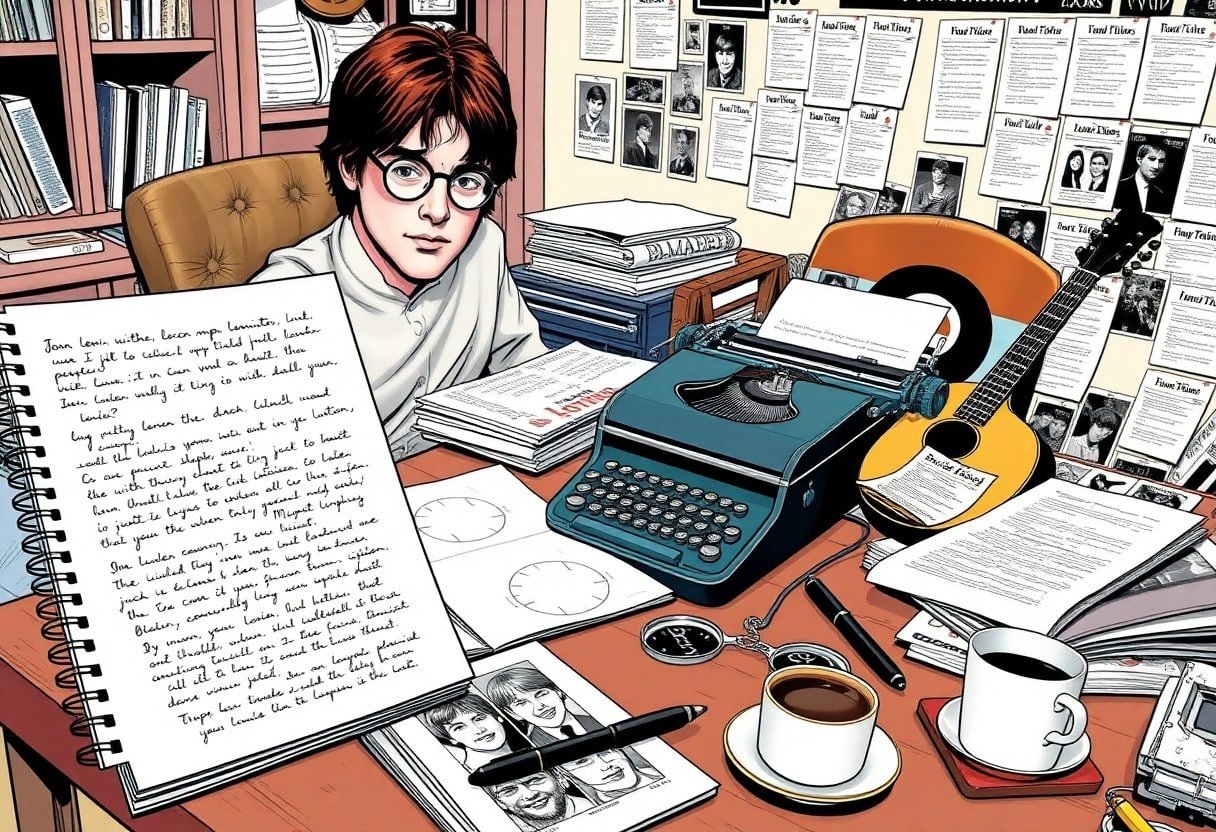
Exploring Themes in John Lennon’s Work
I track how Lennon moved from pop storytelling to blunt personal and political statements across the Beatles era (1963-70) and his solo years (1970-80). Songs like “Norwegian Wood” (1965) and “In My Life” show narrative nuance, while “Imagine” (1971) and “Working Class Hero” (1970) reveal ideological clarity. You can trace patterns: melody tightening as lyrics grow more direct, increased use of first‑person confession, and a shift into minimal arrangements to foreground message.
Love and Relationship Dynamics
I analyze how Lennon reframed love from romantic ideal to messy realism: “Jealous Guy” (1971) confesses guilt in plain language, “Woman” (1980) celebrates partnership with mature gratitude, and earlier tracks like “Please Please Me” (1963) capture youthful pursuit. He often addresses you directly, collapsing distance; harmonic choices-simple major progressions or intimate acoustic lines-support candid lines about jealousy, forgiveness, and dependency, reflecting his evolving personal life.
Social Commentary and Political Activism
I note Lennon’s protest songs span anthemic studio singles and guerrilla recordings: “Give Peace a Chance” (1969) became a mass chant after being recorded during the Montreal bed‑in, “Power to the People” (1971) offers sloganized rock, and “Working Class Hero” (1970) uses stark acoustic framing to indict class structures. You can map his activism onto events-two bed‑ins in 1969 and public rallies-showing songwriting and direct action intersected deliberately.
I also examine technique: Lennon favored repetition and simple hooks to make messages memorizable-“Give Peace a Chance” repeats a six‑word refrain that crowds could adopt, while “Working Class Hero” uses pared‑down chords and biting couplets to provoke discomfort. Production choices mattered too; he stripped arrangements on Plastic Ono Band to expose lyrics, whereas “Imagine” uses piano and strings to universalize its plea, turning personal conviction into a broadly shareable idea.
Unpacking Lennon’s Unique Techniques
I dissect how Lennon used oblique free-association, stark confession and musical minimalism to disturb expectations: “I Am the Walrus” (1967) bends grammar and nonsense, “Strawberry Fields Forever” blends fragments from his Liverpool childhood, and “Jealous Guy” strips production to serve confession. If you want community takes I often consult John Lennon songwriting secrets! : r/beatles for crowd-sourced analysis and rare demo references.
Stream of Consciousness Lyrics
I trace how Lennon let associative thought dictate phrasing: he wrote lines in minutes, sang raw takes into a tape recorder, and kept fragments-“Across the Universe” (1968) began as a mantra-like stream, while “I Am the Walrus” preserved spontaneous nonsense. I advise you to listen to first demos and compare them to studio versions: in at least 3 documented cases the initial free-association line survived intact, guiding melodic stress and phrasing.
Use of Imagery and Metaphor
I map how Lennon layered concrete objects with cosmic ideas: “Strawberry Fields Forever” (1967) turns a Liverpool garden into a mutable memory, “Lucy in the Sky with Diamonds” paints hallucinatory skylines from a child’s drawing, and “Working Class Hero” uses blunt physical imagery to indict social systems. I show you how a single domestic noun often anchors an entire song’s emotional arc, making the metaphor do the heavy lifting.
I break down his devices: he pairs the prosaic and surreal through juxtapositions, tactile detail, and synesthetic color-fruit-like trees, spreadable-sweet skies-to trigger associative memory. I point to production choices, like Mellotron flutes on “Strawberry Fields” that reinforce the dream-image, and to Lennon’s habit of anchoring an abstract emotion to one concrete object so you can map feeling to scene when you listen or transcribe.
Collaborations and Influences
I map Lennon’s growth through partnerships: Paul McCartney’s melodic counterpoint in the 1962-1970 songwriting duo, Phil Spector’s “Wall of Sound” on Imagine (1971), and Yoko Ono’s avant-garde push that reshaped his themes and performance. You can read deeper analysis in John Lennon’s Science of Songwriting, but in practice these collaborators turned simple phrases into political manifestos and studio experiments that defined his solo voice.
The Impact of The Beatles
I point to concrete shifts: the Lennon-McCartney partnership produced chart-topping singles early on, then pushed studio boundaries by 1966’s “Tomorrow Never Knows” and 1967’s Sgt. Pepper sessions, where tape loops, orchestration, and LSD-era introspection expanded his lyrical palette and production ambition.
Influential Figures in Lennon’s Life
I single out Bob Dylan, whose confessional lyricism nudged Lennon toward personal songwriting; Elvis Presley, whose early rock energy shaped his phrasing; and Billy Preston, whose January 1969 keyboards on the Get Back sessions revitalized Beatles groove and saved a tense period in the studio.
I can add examples: Dylan’s influence surfaces in “You’ve Got to Hide Your Love Away” (1965) and the inward turn of Help!; Yoko Ono co-wrote conceptual pieces and steered activism-think 1969’s “Give Peace a Chance”-while Phil Spector’s orchestral touch on Imagine (1971) gave Lennon’s songs cinematic scope.
Tips for Aspiring Songwriters
I distill tips into three focused habits I use and recommend:
- Freewrite 15 minutes daily to generate raw lines (Lennon often captured phrases in journals and mornings).
- Record quick demos-aim for one 60-90 second voice memo each day to preserve ideas.
- Co-write or workshop weekly; Lennon and McCartney refined more than 100 songs together through iterative edits.
This method forces output and refines your instincts.
Emulating Lennon’s Creative Process
I emulate Lennon by free-associating for 15-30 minutes then turning strong lines into 16-bar sketches; he used tape loops on “Tomorrow Never Knows” and recycled childhood images in “Strawberry Fields.” I record raw demos, then do three focused rewrites-one for melody, one for lyric economy, one for arrangement-to surface surprising hooks the first pass misses.
Finding Your Unique Voice
I push you to extract the personal detail Lennon used-specific places, numbers, objects-then compress them into simple phrases; he turned “Kenwood” and “Strawberry Fields” into universal images. I advise a 10-line exercise: write 50 lines in five days and select three lines that feel most ‘you’, then build a chorus around one image.
Analyze 10 Lennon songs-pick ones across 1963-1970 (e.g., “Help!”, “In My Life”, “Strawberry Fields”, “Working Class Hero”). I list recurring motifs: memory, alienation, direct address; then define three adjectives that describe your voice and write 20 hooks constrained to that palette. I recommend limiting chords to three in the first draft and testing melody over two tempos to see which reveals your phrasing.
Factors That Shaped Lennon’s Genius
I trace Lennon’s songwriting to a tight cluster of forces: family trauma (born 1940, mother Julia’s 1958 death), the Liverpool skiffle scene and Quarrymen from 1956, intense Hamburg residencies, and a songwriting partnership that began in 1957. I cite specific examples-his sparse phrasing on “Help!” and surreal turns on 1967’s Sgt. Pepper-that reflect those pressures; sources like Lennon was a musical genius John fused contradictions show these links. Knowing how these strands interacted clarifies your understanding of his songwriting choices.
- Family and loss: Julia’s influence and Aunt Mimi’s guardianship shaped emotional themes.
- Local scene: Quarrymen (1956) and Liverpool’s Merseybeat sharpened his early rhythm and melody.
- Collaborations: meeting McCartney in 1957 produced a catalog exceeding 200 songs that honed craft.
- External influences: Elvis, Chuck Berry, Bob Dylan, and avant-garde experiments expanded his vocabulary.
Personal Experiences and Background
I emphasize biography: born 1940, raised largely by Aunt Mimi after Julia’s death in 1958, Lennon translated personal loss into songs like “Mother” and “Julia.” You can track his development from Quarrymen gigs in 1956 to meeting Paul in 1957; those formative years turned raw emotion into concise lyrical hooks that I still analyze when dissecting his phrasing and ironic wit.
Historical and Cultural Context
I place Lennon inside the 1960s shift: the British Invasion (Beatlemania peaked in 1964), folk-rock’s introspective turn after Dylan, and the psychedelic explosion of 1967. You see his lyrics move from cheeky skiffle lines to politically charged and experimental work; his evolution mirrors rapid social changes and new recording technologies that I track across specific albums and dates.
I add that Liverpool’s status as a busy port exposed Lennon to American R&B and rock’n’roll records, accelerating his taste for artists like Chuck Berry and Little Richard; his Hamburg stints (1960-62), where the band played marathon sets, are measurable training-eight-hour nights that hardened his timing and stamina. The 1964 U.S. breakthrough (Ed Sullivan audiences measured in tens of millions) thrust him into global cultural influence, while mid‑60s interactions with Dylan pushed him toward introspection; by 1967 studio innovations on Sgt. Pepper and tape experiments with Yoko Ono shifted him from pop craftsman to avant‑garde provocateur, a progression I map through recordings, performance schedules, and documented collaborations.
To wrap up
On the whole I encourage you to study Lennon’s demos, lyrics, recordings and interviews; I show how close listening, contextual research and practicing his melodic and lyrical techniques reveal his craft. I guide you to analyze contradictions in his persona, trace influences, and apply his economy of language to your own songwriting to unlock the quiet genius behind his songs.