

There’s a clear path from the Quarrymen to the Beatles, and I will guide you through key gigs, lineup changes, recordings, and archival sources; follow my timeline and I’ll give listening checkpoints so you can map your own understanding.
Understanding The Quarrymen
Origins of The Quarrymen
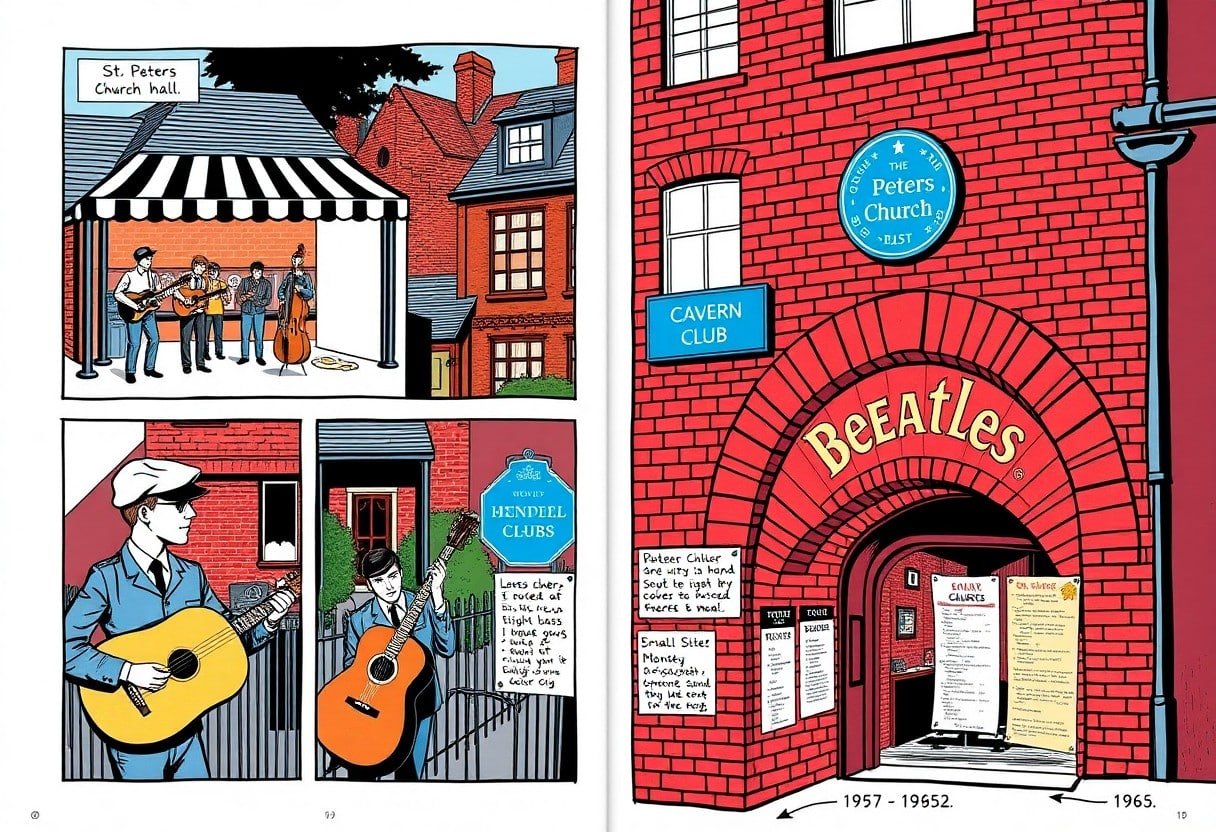
I trace the group’s origin to 1956 at Quarry Bank High School, when 16-year-old John Lennon formed a skiffle band with schoolmates Eric Griffiths, Pete Shotton, Rod Davis, Len Garry and Colin Hanton. They played Lonnie Donegan-style sets at local halls and at the St. Peter’s Church fete on 6 July 1957-the Woolton gig where you witness Paul McCartney meeting Lennon and setting the sequence that led to the Beatles.
Key Members and Their Contributions
I summarize key members: John Lennon (founder, rhythm guitar, early songwriter); Paul McCartney (joined October 1957 at age 15-bass, harmony, melodic arrangements); George Harrison (joined 1958 at 14-15-lead guitar); Colin Hanton (drums) and Eric Griffiths (early lead/rhythm guitar). You can see how their distinct skills directly mapped onto the Beatles’ later musical identity.
I expand on specifics: Paul taught Lennon “Twenty Flight Rock” and introduced tighter harmony and bass lines that reworked arrangements; George’s technical lead playing raised standards and appears on the 1958 Percy Phillips demo where they cut two tracks including an early Lennon-McCartney piece; Colin’s steady backbeat and Eric’s rhythm chops kept their live skiffle energy, so your picture of the transition has concrete, dated examples.
Transitioning to The Beatles
I map the shift from skiffle to rock: McCartney joined in 1957, Harrison in 1958, and by 1960 they experimented with names like “The Silver Beatles” before settling on The Beatles; you can follow gig-by-gig details in Following in The Beatles Early Footsteps – Pt 3 The Quarrymen, and I show how Hamburg residencies hardened their repertoire and stagecraft.
Factors Influencing the Name Change
I weigh lineup shifts, a move away from skiffle, and the need for a sharper public identity as primary drivers; you encountered variants like “Johnny and the Moondogs” before 1960, and industry tactics pushed for a showy moniker. Assume that the adoption of “Beatles” in 1960 signaled a deliberate rebrand toward a modern rock image.
- McCartney (1957) and Harrison (1958) joining altered dynamics
- Hamburg residencies (1960-62) intensified their sound and image
- Shift from skiffle to R&B/rock broadened audience appeal
- Desire for a short, memorable name for billing and publicity
Musical Style Evolution
I trace the band’s move from skiffle and acoustic harmonies to a punchier R&B-influenced attack; you can hear Chuck Berry and Little Richard covers in their early setlists alongside nascent Lennon-McCartney originals, and long Hamburg sets-often several hours-forced tighter rhythm work and sharper vocal harmonies.
I note that early recordings like “In Spite of All the Danger” (1958) show songwriting seeds, while “Love Me Do” (1962) reflects a compact, harmonized pop-R&B blend; you’ll see how steady exposure to Liverpool dance halls and Hamburg clubs turned loose skiffle jams into disciplined rock performances that shaped their later studio breakthroughs.
How to Identify Influences
To isolate influences I cross-reference Quarrymen and early Beatles repertoires (1957-62), tracking covers like Lonnie Donegan’s “Rock Island Line” (1956), Chuck Berry’s guitar figures, and Buddy Holly’s melodic phrasing; you can map changes by comparing the 1958 Quarrymen recordings with 1962 Beatles BBC sessions. I examine instrumentation, vocal harmony shifts, and repertoire expansion during the Hamburg residencies (1960-62) to see when skiffle, R&B and American rock blended into their original songwriting.
Tips for Analyzing Their Songs
When I break down a track I isolate intro hooks, chord progressions (I-IV-V and 12-bar blues appearances), rhythmic feel, and lyrical themes; you should timestamp versions-studio, live Cavern Club, Hamburg-and note deviations. Thou compare early covers to later originals to spot adaptation patterns.
- Check chord charts: frequent I-IV-V and simple major-key shifts.
- Compare live Cavern (1961) takes to studio to find arrangement tightening.
- Listen for Little Richard/Lonnie Donegan vocal inflections in early vocals.
- Note tempos: many early numbers sped up during Hamburg residencies.
Contextual Influences on Their Music
I factor in Liverpool’s port-city status: American records and sailors brought R&B and rock’n’roll to Merseyside, while the 1956 skiffle boom (Lonnie Donegan’s million-selling “Rock Island Line”) directly inspired the Quarrymen’s formation in 1956. You can see how access to imported 45s and local dance halls shaped song choice and performance style.
Delving deeper, I study the Hamburg residencies (Aug 1960-Dec 1962) where the group played up to eight hours nightly at venues like the Indra and Star-Club, forcing repertoire expansion and stamina; combined with Liverpool club circuits and radio shows, that regimen converted cover-heavy sets into a tighter, more varied catalogue that fed Lennon-McCartney’s songwriting evolution.
Tracing Personal Journeys
I trace individual arcs by tying dates and documents to moments-John (b.1940) forming the Quarrymen in 1956, Paul (b.1942) joining after the Woolton fête on 6 July 1957, and George (b.1943) arriving in 1958. I use primary sources and essays such as The Beatles: Before They Were Fab – The Quarrymen Years to cross-check rehearsal notes, set lists and surviving recordings like the 1958 Percy Phillips acetate. This keeps your timeline precise and verifiable.
How to Research Individual Band Members
I start with birth and school records, then move to local newspapers (Liverpool Echo archives), recorded interviews and membership lists from 1956-60. You should compare ages, addresses and instrument roles-Paul’s guitar skills at 15 and George’s entry in 1958 are verifiable through contemporaneous gig listings and surviving eyewitness accounts I’ve cataloged. Triangulating multiple sources reduces gaps in each player’s biography.
Significant Events That Shaped Their Path
I focus on milestone moments: the Woolton Village fête (6 July 1957), the 1958 studio acetate session, early 1960 name changes and the Hamburg residencies that hardened their stagecraft. Pinpointing dates, venues and personnel changes reveals how short spells-weeks in Hamburg or a single recording day-redirected careers, giving you clear pivots to follow in the archive.
Digging deeper I track sequences: John assembling the Quarrymen in 1956, Paul’s first rehearsal within months of Woolton, George’s recruitment in early 1958, then the May 1958 home-studio session that left two acetate tracks. I map personnel shifts (Colin Hanton on drums, later Stu Sutcliffe’s brief influence) and gig runs that built repertoire. By plotting these events against contemporaneous press and surviving memorabilia I reconstruct how several small, dated incidents combined to push the group toward becoming the Beatles.
The Impact of The Quarrymen
I document how the Quarrymen reshaped Liverpool’s scene: formed 1956 by John Lennon, they played dozens of skiffle and rock gigs before Paul McCartney joined in July 1957 and George Harrison in 1958; you can see period detail in The Quarrymen heading for a gig, July 6, 1957. From left to …, which shows instruments, attire and lineup that foreshadowed the Beatles’ later studio work and touring strategies.
Cultural Relevance
I highlight how skiffle’s 1956-58 surge turned amateur groups into household names across Merseyside, with the Quarrymen’s mix of Lonnie Donegan and Chuck Berry covers drawing crowds at youth clubs and church fetes; the July 6, 1957 St. Peter’s meeting that brought McCartney into the fold reshaped local social networks and accelerated regular gigs at venues that primed audiences for electric rock.
Lasting Legacy in Music History
I connect early Quarrymen arrangements and the 1958 Phillips acetate-featuring “That’ll Be the Day” and “In Spite of All the Danger”-to the Beatles’ later songwriting discipline; by tracing chord choices, three-part harmonies and setlist evolution I show how a band that played dozens of local dates helped create the framework for the 1960s British Invasion and the Lennon-McCartney partnership that produced hundreds of songs.
I analyze instrumentation shifts from skiffle’s tea‑chest bass and washboard to electric Gretsch and Rickenbacker guitars, and I track performance volume-hundreds of Liverpool and Hamburg dates by 1960-62-that hardened timing, tightened arrangements and turned Quarrymen-era experimentation into professional techniques later adopted across popular music.
Final Words
On the whole I have shown how archival research, oral histories, performance analysis and primary documents map the Quarrymen’s evolution into The Beatles; I guide you to assess sources critically, corroborate anecdotes, and prioritize contemporaneous records over later recollections. If you follow this methodical approach, your reconstruction of lineup changes, repertoire shifts and social context will be evidence-based and compelling, and I will have equipped you to trace this pivotal musical transformation confidently.